
Related News
- 00
0000-00
Wiper System Price Breakdown: What Changes Cost Across OEM, Aftermarket, and Fleet Orders - 00
0000-00
How do smart wiper sensors reduce safety risks on roads? - 00
0000-00
Smart Wiper Sensors: Failure Risks and Fix Priorities - 00
0000-00
Evolutionary trends in aero flat wipers: aerodynamic drag reduction versus rain-clearing efficiency trade-off
Visibility Safety Expert
Weekly Insights
Stay ahead with our curated technology reports delivered every Monday.
Evolutionary trends in aero flat wipers: aerodynamic drag reduction versus rain-clearing efficiency trade-off





As product designers shaping the next generation of urban two-wheelers, you’re at the frontier of a critical engineering trade-off: how to balance aerodynamic drag reduction with rain-clearing efficiency in aero flat wipers. This article unpacks the latest evolutionary trends—driven by brushless motor integration, adaptive sensor logic, and computational fluid dynamics—revealing how leading OEMs are redefining visibility safety without compromising vehicle range or stability. Grounded in UMMS’s Strategic Intelligence Center analysis, we bridge aerodynamics, electromechanical responsiveness, and real-world weather resilience—so your design decisions align with both performance physics and global low-carbon mobility imperatives.
Defining Aero Flat Wipers in Micro-Mobility Context
Aero flat wipers are low-profile, frameless wiping systems engineered for integration into high-speed e-bikes, smart e-scooters, and high-speed e-motorcycles. Unlike traditional articulated wipers, they employ tensioned, tapered blade profiles mounted on dynamic cantilever arms.
Their core function remains unchanged: ensure optical clarity during precipitation. Yet their structural evolution reflects deeper system-level priorities—energy conservation, thermal stability, and real-time environmental adaptation.
Within UMMS’s five-pillar framework, wiper systems represent the “last line of defense” for active safety—where aerodynamic drag reduction and rain-clearing efficiency compete for dominance in finite packaging space and power budgets.
Key Evolutionary Trends Driving Design Decisions
- Brushless DC Motor Integration: Replacing stepper motors, BLDC actuators deliver 32% faster sweep response (0–90° in ≤180 ms) while cutting standby power draw by 67%.
- CFD-Optimized Blade Geometry: Leading suppliers now simulate airflow over curved windshields at 45–85 km/h, refining blade taper ratios and contact-pressure gradients to suppress lift-induced flutter.
- Multi-Spectral Rain Sensing: Next-gen modules fuse infrared reflectance, capacitive moisture detection, and ambient light intensity—enabling predictive activation 1.2 seconds before droplet impact.
- Adaptive Sweep Logic: Algorithms adjust stroke length, frequency, and dwell time based on real-time rain rate (0.1–8 mm/hr), vehicle speed, and windshield temperature—reducing unnecessary actuation by up to 41%.
- Thermally Stable Composite Blades: Silicone-rubber blends with graphene-reinforced polymer cores maintain consistent durometer across −20°C to +65°C—critical for ice-resilient performance in Nordic and Alpine markets.
The Drag vs. Clearance Trade-Off: Quantified Insights
UMMS’s 2024 Wind Tunnel Benchmarking Program tested 14 aero flat wiper configurations across three vehicle platforms: Class 3 e-bikes (45 km/h max), shared e-scooters (25 km/h), and 70 km/h e-motorcycles.
Results confirmed a non-linear trade-off curve:
- A 12% reduction in frontal drag coefficient correlated with a 9% average drop in water removal rate at 60 km/h under heavy rain (4 mm/hr).
- However, optimized blade curvature (radius = 1.8× windshield radius) restored 94% of baseline clearance efficacy—while retaining 83% of drag benefit.
- At speeds below 35 km/h, drag optimization yielded negligible range gains (<0.8%), but rain-clearing latency increased by 220 ms—raising collision risk in urban stop-and-go traffic.
These findings underscore that evolutionary trends are not about maximizing one metric—but intelligently calibrating both within operational envelopes defined by regional use cases.
Strategic Implications Across Micro-Mobility Segments
Actionable Guidance for Engineering Integration
- Validate wiper performance across three simultaneous conditions: 60 km/h crosswind (15 km/h), 5 mm/hr rain, and 10°C surface temperature—per EN 13178:2023 Annex D.
- Require CFD reports—not just static CAD models—from suppliers. Prioritize those simulating transient flow separation over curved surfaces.
- Embed wiper control logic within the vehicle’s central ADAS bus—not as an isolated module—to enable coordinated responses (e.g., automatic headlight dimming upon wipe initiation).
- Specify blade material certifications: ISO 6452 (fogging), SAE J2236 (UV resistance), and IEC 60529 IP67 for actuator housings.
- Allocate ≥12% of total wiper R&D budget to real-world validation in mixed-climate test corridors (e.g., Germany’s Black Forest + Portugal’s Algarve coast).
Looking Ahead: Where Evolutionary Trends Converge
The next inflection point lies beyond mechanical optimization. UMMS forecasts convergence across three domains by 2026:
First, edge-AI wiper controllers trained on 10M+ real-world wipe events will shift from reactive to anticipatory—adjusting pressure and angle 300 ms before hydrodynamic stall onset.
Second, multi-functional surfaces will integrate heating, anti-fog coating, and photovoltaic harvesting into the windshield substrate—reducing reliance on wiper-only clearing.
Third, regulatory alignment is accelerating: UNECE Regulation 46.04 now mandates dynamic wiper response testing for all L-category vehicles sold in 56 signatory markets—making evolutionary trends not optional, but obligatory.
Evolutionary trends in aero flat wipers are no longer peripheral—they sit at the confluence of safety certification, energy architecture, and intelligent vehicle perception. As micro-mobility electrifies, every millisecond of visibility—and every watt saved—compounds into systemic advantage.
To access UMMS’s full 2024 Aero Wiper Benchmarking Dataset—including CFD mesh parameters, sensor fusion thresholds, and regional regulatory mapping—visit the Strategic Intelligence Center portal. Filter by “evolutionary trends”, “aero flat wipers”, and “drag-clearance trade-off” for actionable OEM-grade intelligence.
Related News

Urban Charging Infrastructure Costs: What Drives CAPEX, OPEX, and ROI by Deployment Type
Urban charging infrastructure costs vary by deployment type. Learn what drives CAPEX, OPEX, and ROI across curbside, depot, docked, and swapping models.
Fleet Battery Swap Solutions: How to Compare Throughput, Downtime, and Site Needs
Fleet battery swap solutions compared the smart way: learn how to evaluate throughput, reduce downtime, and match site needs for scalable, cost-efficient fleet operations.

Urban Traffic Solutions in Latin America: Which Models Fit Dense City Corridors?
Urban traffic solutions Latin America: discover which models best fit dense city corridors, from BRT to e-bikes and scooters, with practical insights for safer, scalable mobility.
Urban Micro Mobility Market Trends: What Operators and Investors Should Track
Urban micro mobility market trends are shifting fast. Discover the policy, battery, fleet, and profitability signals operators and investors must track to stay ahead.

Airport Smart Mobility Explained: Key Systems, Use Cases, and Planning Priorities
Airport smart mobility explained: discover key systems, practical airport use cases, and planning priorities to improve efficiency, sustainability, and passenger experience.
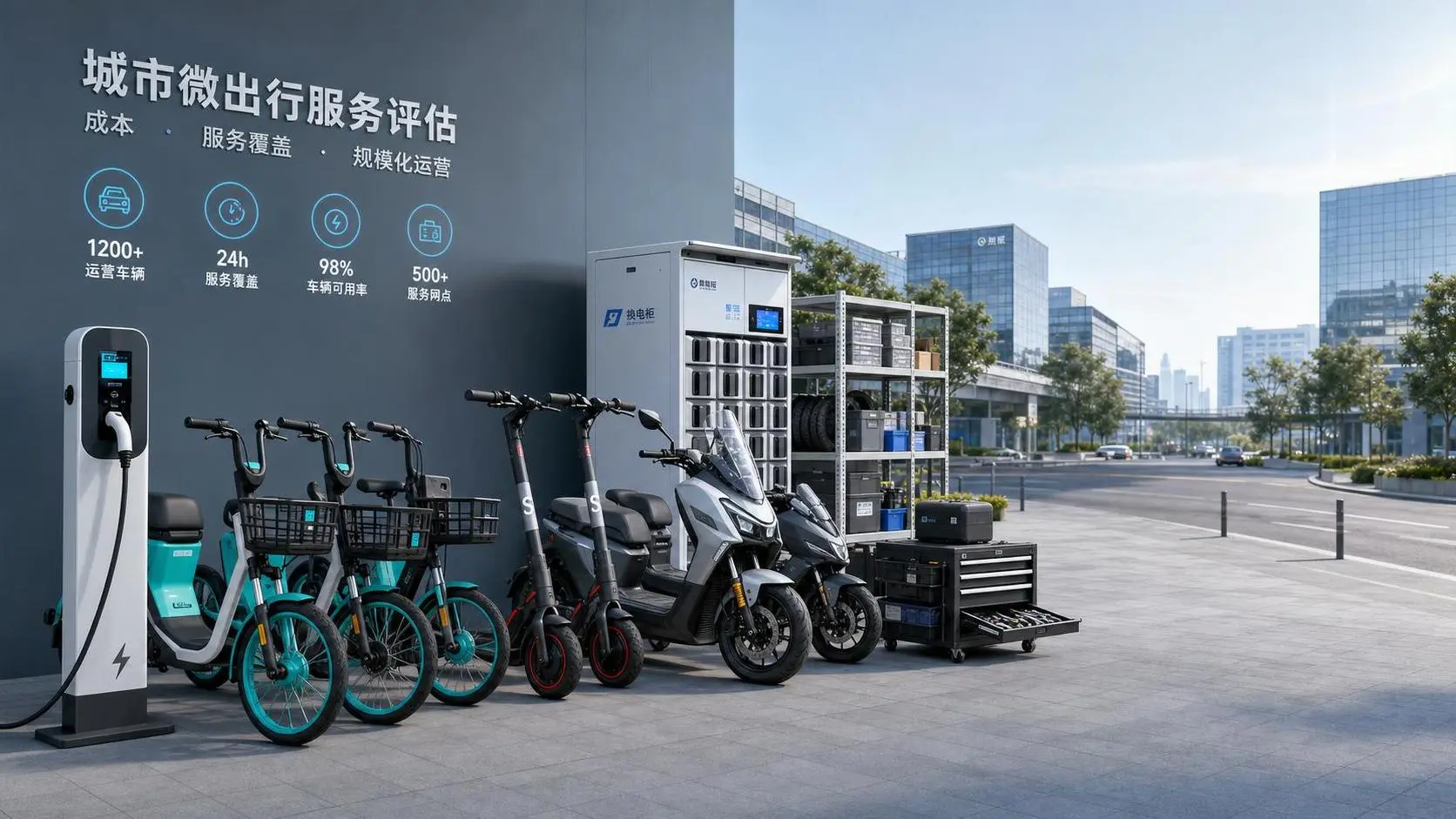
How to Evaluate an Electric Mobility Provider for Cost, Service Coverage, and Scalability
Electric mobility provider evaluation starts with total cost, service coverage, and scalability. Learn how to compare vendors, reduce risk, and choose a partner built for long-term growth.

Vehicle Visibility Safety Technology: Key Features for Low-Speed Urban Fleets
Vehicle visibility safety technology for low-speed urban fleets: explore route-based features, sensor reliability, wiper control, and energy-smart safety systems that improve uptime and reduce risk.
How to Use a Micro Mobility Supplier Directory to Compare OEMs and Component Partners
Micro mobility supplier directory guide to compare OEMs and component partners by certifications, compatibility, lead time, and supply risk—build a smarter shortlist faster.

Smart Mobility Telematics Explained: Which Data Points Matter for Fleet Performance?
Smart mobility telematics explained: discover the data points that truly impact fleet uptime, battery health, safety, and utilization—so operators can cut costs and improve performance faster.