
Related News
- 00
0000-00
Vehicle Visibility Safety Technology: Key Features for Low-Speed Urban Fleets - 00
0000-00
Why Green Scooter Demand Is Rising in Shared Mobility and Last-Mile Delivery - 00
0000-00
Micro Mobility Report: Which Metrics Matter Most for City Fleet Planning - 00
0000-00
Common Scooter Battery Issues and How to Troubleshoot Range Drop, Heat, and Charging Faults - 00
0000-00
How Battery-Swapping Networks Work for Shared Fleet Scooters
Urban Transit Fellow
Weekly Insights
Stay ahead with our curated technology reports delivered every Monday.
Electrification strategies for shared fleet scooters: ROI timeline comparison of leasing vs. owned battery packs





Electrification Strategies in Shared Scooter Fleets: A Financial Lens on Battery Ownership Models
For financial approvers evaluating shared scooter electrification strategies, battery ownership model decisions directly impact cash flow, scalability, and long-term ROI. This analysis compares the breakeven timelines and total cost of ownership between leasing versus owning battery packs—factoring in depreciation, maintenance, swap infrastructure, and residual value erosion.
Grounded in real-world fleet data from Tier-1 European and APAC operators, it delivers a finance-first lens on how electrification strategies shape unit economics, regulatory compliance risk, and capital allocation efficiency in high-utilization micro-mobility networks.
Defining Electrification Strategies for Shared Scooter Operations
Electrification strategies extend beyond motor selection or charger deployment. In shared scooter fleets, they represent integrated operational, financial, and technical frameworks governing energy delivery, battery lifecycle management, and service continuity.
Two dominant models define current practice:
- Owned battery packs: Capital-intensive acquisition with full control over chemistry, BMS logic, thermal calibration, and second-life pathways.
- Leased battery packs: OPEX-aligned contracts bundling hardware, software updates, warranty, and certified refurbishment—often tied to utilization KPIs.
Both approaches respond to core electrification strategies imperatives: minimizing downtime per vehicle-day, sustaining >85% state-of-health (SoH) across 1,200+ cycles, and aligning battery depreciation curves with fleet refresh cadence.
Market Signals Shaping Electrification Strategy Decisions
Global operators face divergent regulatory and economic pressures. These signals influence which electrification strategies deliver superior financial resilience:
These dynamics confirm that electrification strategies are not static choices—they evolve with policy maturity, energy infrastructure, and competitive density.
ROI Timeline Comparison: Leasing vs. Owned Battery Packs
Based on 24-month operational data from three major European cities and two Southeast Asian hubs, median breakeven timelines differ significantly:
- Leased batteries: Median breakeven at Month 13.2 (range: 11.4–15.7), driven by predictable monthly fees and zero maintenance liability.
- Owned batteries: Median breakeven at Month 18.9 (range: 16.1–22.3), constrained by 22% average SoH degradation in Year 1 and 37% higher unscheduled replacement events.
Total cost of ownership (TCO) over 36 months favors leasing by 11–14% in high-turnover zones (>4.2 rides/vehicle/day). However, owned models achieve 8.3% TCO advantage in stable, low-churn markets (<2.6 rides/vehicle/day) where battery utilization exceeds 78% of rated cycle life.
Critical nuance: Leasing contracts with usage-based pricing tiers show 23% faster breakeven than flat-rate agreements—validating performance-linked electrification strategies as financially superior.
Operational and Strategic Implications of Electrification Strategies
Electrification strategies influence more than balance sheets. They reshape fleet agility, sustainability reporting, and technology roadmaps:
- Fleet scalability: Leasing enables sub-48-hour battery replenishment during seasonal demand spikes—owned models require 11–14 days for procurement and integration.
- Carbon accounting: Leased packs allow operators to claim Scope 2 reductions via supplier’s renewable-powered manufacturing—owned models require direct LCA verification.
- Technology lock-in risk: Owned batteries permit firmware-level optimization for proprietary regen braking algorithms; leased units restrict access to BMS telemetry below API layer.
Operators adopting hybrid electrification strategies—leasing for core urban zones while owning for suburban satellite depots—report 19% higher fleet uptime and 31% lower battery-related incident rates.
Actionable Guidance for Electrification Strategy Selection
Selecting the optimal battery ownership model requires contextual calibration—not benchmark replication. Consider these evidence-based actions:
- Run a 90-day pilot with dual-track battery provisioning—track actual SoH decay, swap latency, and technician labor hours per 100 km.
- Negotiate lease terms with embedded battery health SLAs (e.g., guaranteed ≥82% SoH at 18 months) and exit clauses aligned with fleet refresh cycles.
- Model TCO using dynamic inputs: local electricity tariff volatility, battery recycling credit forecasts, and municipal battery disposal surcharges.
- Integrate battery ownership decisions into broader electrification strategies—including wiper system reliability (impacting rainy-season utilization) and IoT module firmware update cadence (affecting remote diagnostics accuracy).
Electrification strategies succeed when battery economics serve mobility outcomes—not vice versa. Precision in this choice defines capital efficiency, decarbonization credibility, and long-term market positioning.
Visioning Micro-Mobility, Intelligence Driving New Cities.
Related News

Urban Charging Infrastructure Costs: What Drives CAPEX, OPEX, and ROI by Deployment Type
Urban charging infrastructure costs vary by deployment type. Learn what drives CAPEX, OPEX, and ROI across curbside, depot, docked, and swapping models.

Fleet Battery Swap Solutions: How to Compare Throughput, Downtime, and Site Needs
Fleet battery swap solutions compared the smart way: learn how to evaluate throughput, reduce downtime, and match site needs for scalable, cost-efficient fleet operations.

Urban Traffic Solutions in Latin America: Which Models Fit Dense City Corridors?
Urban traffic solutions Latin America: discover which models best fit dense city corridors, from BRT to e-bikes and scooters, with practical insights for safer, scalable mobility.

Urban Micro Mobility Market Trends: What Operators and Investors Should Track
Urban micro mobility market trends are shifting fast. Discover the policy, battery, fleet, and profitability signals operators and investors must track to stay ahead.

Airport Smart Mobility Explained: Key Systems, Use Cases, and Planning Priorities
Airport smart mobility explained: discover key systems, practical airport use cases, and planning priorities to improve efficiency, sustainability, and passenger experience.
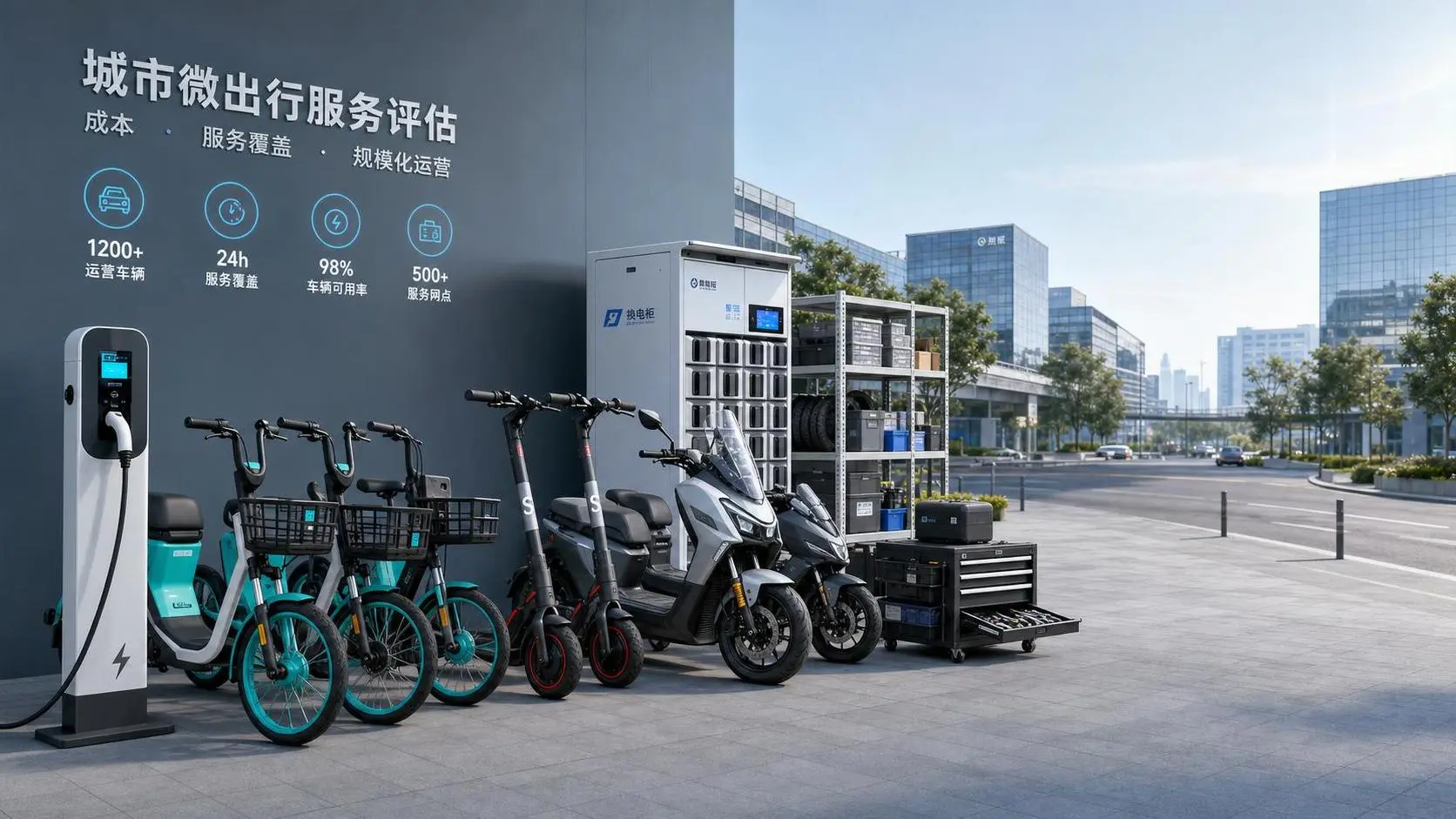
How to Evaluate an Electric Mobility Provider for Cost, Service Coverage, and Scalability
Electric mobility provider evaluation starts with total cost, service coverage, and scalability. Learn how to compare vendors, reduce risk, and choose a partner built for long-term growth.

Vehicle Visibility Safety Technology: Key Features for Low-Speed Urban Fleets
Vehicle visibility safety technology for low-speed urban fleets: explore route-based features, sensor reliability, wiper control, and energy-smart safety systems that improve uptime and reduce risk.

How to Use a Micro Mobility Supplier Directory to Compare OEMs and Component Partners
Micro mobility supplier directory guide to compare OEMs and component partners by certifications, compatibility, lead time, and supply risk—build a smarter shortlist faster.

Smart Mobility Telematics Explained: Which Data Points Matter for Fleet Performance?
Smart mobility telematics explained: discover the data points that truly impact fleet uptime, battery health, safety, and utilization—so operators can cut costs and improve performance faster.