
Related News
- 00
0000-00
Battery Swapping Network Cost: What Drives Setup and Operating Expenses? - 00
0000-00
Battery Swapping in China vs Charging: Which Model Fits Shared Scooter Fleets? - 00
0000-00
Thermal Management for Swappable Battery Scooters: Key Design Factors to Compare - 00
0000-00
Battery-Swapping Networks for Motorcycles: Key Cost Drivers and Deployment Models - 00
0000-00
Battery Swapping Cost Breakdown: Station CapEx, Pack Pricing, and Operating Fees
Electric Powertrain Analyst
Weekly Insights
Stay ahead with our curated technology reports delivered every Monday.
Battery Swapping Network Cost: What Drives Setup and Operating Expenses?





Battery Swapping Network Cost: What Drives Setup and Operating Expenses?
Battery swapping network cost is a core variable in any two-wheeler electrification plan. It affects capital structure, rollout speed, service quality, and long-term unit economics.
At first glance, swapping looks simple. Build stations, stock batteries, connect software, and serve riders. In practice, the cost stack is broader and far more strategic.
For operators, OEMs, and infrastructure investors, the real question is not only how much a network costs. It is which cost drivers shape payback, uptime, and scale.
That is why a clear view of battery swapping network cost matters before procurement starts. The strongest networks are usually designed around demand density, battery utilization, and operating discipline.
The Two Main Cost Buckets
Every battery swapping network cost model starts with two categories. The first is setup cost. The second is recurring operating cost.
Setup cost covers station hardware, site preparation, grid connection, software deployment, battery inventory, and launch support. These are the expenses that determine how fast a network can open.
Operating cost includes electricity, maintenance, field service, rent, network monitoring, battery replacement, and customer support. These expenses shape cash burn and service consistency after launch.
A network can look affordable on day one and become expensive later. This usually happens when utilization assumptions are weak or battery logistics are underestimated.
What Raises Initial Battery Swapping Network Cost
1. Station hardware and cabinet design
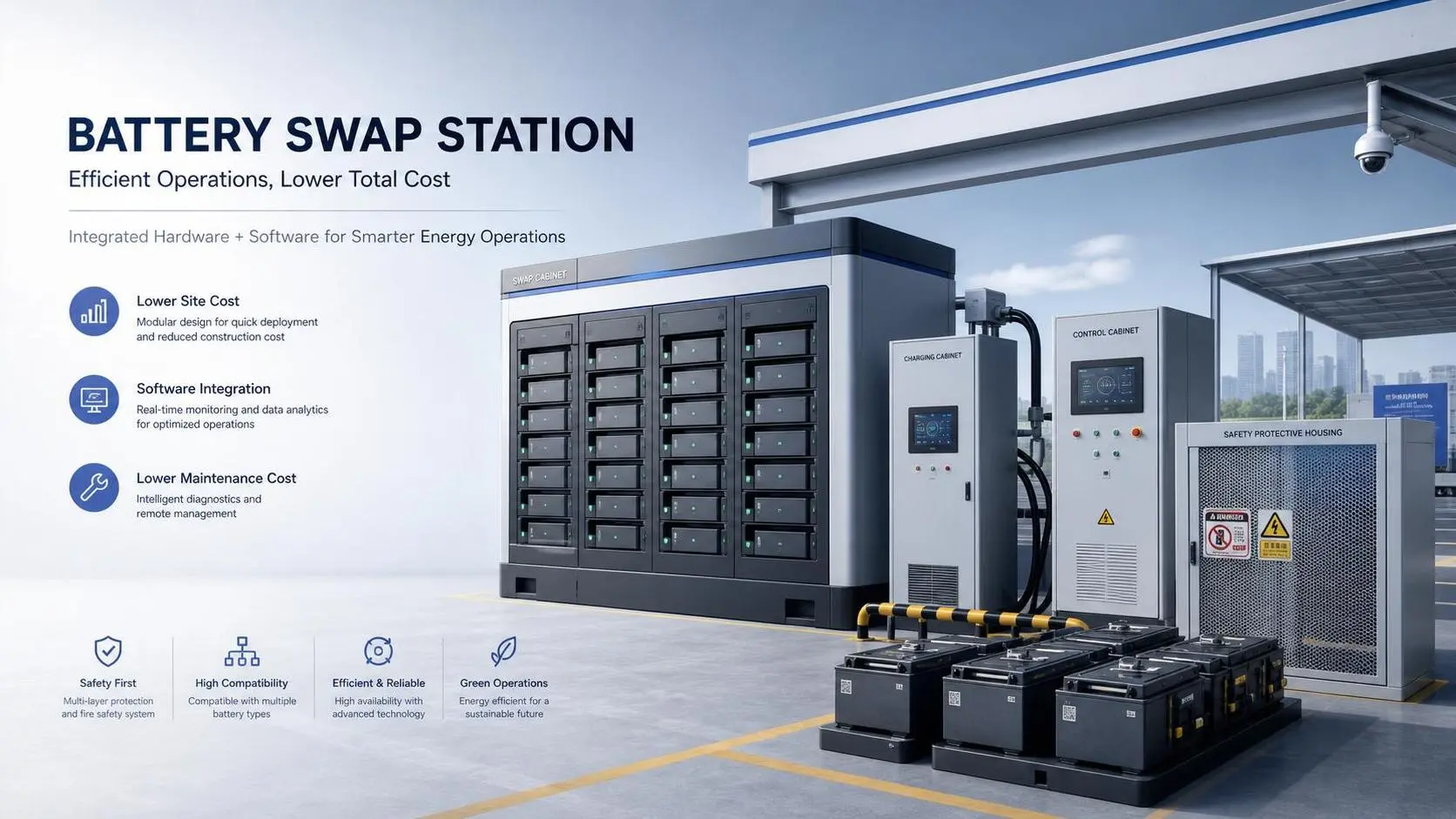
Station hardware is often the most visible line item. Weatherproof enclosures, locking systems, thermal controls, chargers, fire protection, and power electronics all add cost.
Modular cabinets usually reduce deployment friction. However, premium modularity can raise upfront battery swapping network cost if the network size is still uncertain.
2. Battery inventory and spare ratio
Battery inventory is often the largest capital burden. A station is useless without enough charged packs to handle peak demand and charging turnaround.
The spare ratio matters. If each active vehicle needs more than one battery in circulation, battery swapping network cost rises quickly across the fleet.
This becomes even more pronounced in delivery fleets, where daily mileage is high and service windows are tight. More batteries improve uptime, but they also tie up more capital.
3. Site acquisition and civil work
Urban sites vary sharply in cost. Prime convenience locations support higher swap volume, but rent, permits, access upgrades, and utility work may be expensive.
In some cities, local compliance adds hidden spending. Fire codes, battery handling standards, and power approvals can delay rollout and increase setup cost.
4. Software, telemetry, and integration
Modern swapping relies on software as much as hardware. You need battery authentication, station management, payment systems, demand forecasting, and remote diagnostics.
If the network must integrate with fleet tools, rider apps, ERP platforms, or OEM BMS systems, battery swapping network cost rises during deployment but usually improves long-term control.
What Drives Ongoing Operating Expenses
Electricity and charging strategy
Electricity is not just a utility bill. It is a controllable operating lever. Charging during peak tariff periods can materially increase battery swapping network cost.
Smart charging helps reduce this pressure. Load balancing, off-peak charging, and energy management software can lower cost without hurting service availability.
Maintenance and field service
Cabinets, locks, screens, connectors, and cooling systems all require maintenance. If one high-traffic station fails, the impact can spread through the local network.
Preventive service is usually cheaper than reactive repairs. Networks with weak maintenance planning often face a higher battery swapping network cost per completed swap.
Battery aging and replacement
Battery depreciation is one of the biggest lifetime cost drivers. Cycle life, charging behavior, ambient temperature, and abuse events all affect replacement timing.
This is where BMS quality matters. Better cell balancing and health monitoring can slow degradation and reduce battery swapping network cost over several years.
Network operations and support
Operators also carry the cost of dispatching technicians, monitoring assets, handling customer issues, and reconciling transactions. These are easy to overlook during early procurement reviews.
As networks scale, software automation becomes critical. Without it, labor overhead can push battery swapping network cost higher even when station utilization improves.
The Hidden Variables That Change ROI
Two projects with similar hardware quotes can deliver very different economics. The gap often comes from hidden operating variables rather than station price alone.
- Low utilization spreads fixed cost across too few swaps.
- Poor station placement reduces traffic and battery turnover.
- Too many battery formats increase inventory complexity.
- Weak interoperability limits ecosystem scale.
- Slow permit cycles delay revenue while capital is already committed.
From a procurement standpoint, this means the cheapest bid may not produce the lowest battery swapping network cost. The stronger metric is total cost per swap over time.
That calculation should include battery life, station uptime, software fees, utilization assumptions, and replacement schedules. If one of those inputs is weak, ROI can deteriorate fast.
A Practical Cost Review Framework
In real projects, a practical framework keeps decisions grounded. It also helps compare vendors on more than sticker price.
- Map demand density by district, route, and rider type.
- Estimate swaps per day per station under conservative assumptions.
- Define battery spare ratio and expected cycle life.
- Review rent, permits, power access, and local safety rules.
- Model software, service, and replacement cost over three to five years.
- Stress-test uptime risk, seasonality, and fleet growth scenarios.
This kind of review makes battery swapping network cost easier to control. More importantly, it turns procurement into an operating strategy rather than a one-time purchase.
How to Reduce Battery Swapping Network Cost Without Hurting Service
Cost reduction does not have to mean underbuilding. The best results usually come from better matching assets to real demand.
- Standardize battery formats where possible.
- Launch in dense corridors before citywide expansion.
- Use modular stations for phased scaling.
- Adopt predictive maintenance and remote diagnostics.
- Negotiate electricity strategy, not only electricity price.
- Track battery health closely to delay unnecessary replacement.
These actions can lower battery swapping network cost while protecting uptime. They also make scaling more disciplined, especially in fast-growing urban mobility markets.
Final Takeaway
Battery swapping network cost is not defined by hardware alone. It is the combined result of station design, battery inventory, site economics, software architecture, energy strategy, and maintenance discipline.
For any organization evaluating swapping infrastructure, the smartest move is to model full lifecycle cost before procurement is locked. That includes capex, opex, utilization, and battery health assumptions.
A well-built network can deliver fast refueling, strong fleet uptime, and scalable urban coverage. But only if battery swapping network cost is managed with operational realism from the start.
The practical next step is simple: compare suppliers using total cost per swap, not only equipment price. That single shift often leads to better contracts, better rollout choices, and stronger long-term returns.
Related News

Electric Drivetrain Technology Explained: Motors, Controllers, and Efficiency
Electric drivetrain technology explained clearly: compare motors, controllers, thermal management, and efficiency to choose smarter, longer-lasting e-bike, e-scooter, and e-motorcycle systems.
Urban Electric Vehicles Market Trends: Where Demand Is Rising Fastest
Urban electric vehicles market demand is rising fastest in dense cities with strong policy support, better infrastructure, and reliable e-mobility tech. Explore where growth is accelerating next.
Urban Electric Vehicles Market: Key Growth Drivers and Adoption Challenges
Urban electric vehicles market trends, growth drivers, and adoption challenges explained. Discover how policy, battery tech, safety, and urban mobility demand are shaping the next wave.
Battery Swapping Network Cost Breakdown: Hardware, Site Fees, and Maintenance
Battery swapping network cost explained: compare hardware, site fees, software, and maintenance to plan smarter rollouts, reduce downtime, and improve ROI.

How to Use a Market Intelligence Report to Evaluate EV Two-Wheeler Opportunities
Market intelligence report insights for evaluating EV two-wheeler opportunities—compare e-bikes, e-scooters, and e-motorcycles by demand, policy, technology, and channel fit.

Green Scooter Demand: Which Buyer Segments and City Use Cases Are Growing Fast?
Green scooter demand is accelerating across urban commuters, shared fleets, campuses, and delivery routes. Discover the fastest-growing buyer segments and city use cases shaping the market.
Battery Swapping in China vs Charging: Which Model Fits Shared Scooter Fleets?
Battery swapping China vs charging: discover which model keeps shared scooter fleets safer, more efficient, and easier to scale across dense urban markets.
Electric Mobility Challenges Explained: Grid Limits, Charging Access, and TCO
Electric mobility challenges explained: discover how grid limits, charging access, and TCO shape EV adoption, fleet uptime, and smarter micro-mobility growth strategies.
Two Wheeler Electrification Trends: What Is Driving Adoption in Urban Mobility?
Two wheeler electrification trends are reshaping urban mobility through smarter batteries, supportive policy, and flexible transport. Explore what is driving adoption now.